


This is an example page where your customers could reach out to support.
Affirma
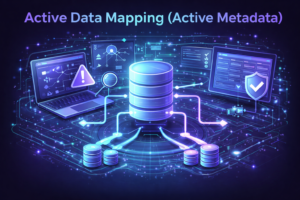
Affirma can automatically infer the appropriate mapping to the enterprise model, assess downstream impact through lineage, and update transformation logic in platforms. Affirma represents a shift from static, manually maintained mappings to a dynamic, self-adapting mapping capability powered by Affirma knowledge graph, semantic model, and lineage intelligence. In this model, Affirma leverages AI/ML and LLM techniques to:
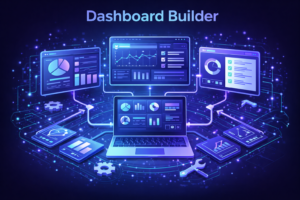
Affirma Dashboard Builder would enable business and technical users to rapidly create trusted, semantically consistent dashboards and reports directly from the Affirma platform by leveraging its knowledge graph, metadata, lineage, and semantic model.
Rather than requiring users to manually identify datasets and define joins, Affirma can automatically surface business-aligned data products, curated metrics, and relationships based on the semantic layer. Users can select concepts such as “Customer,” “Asset,” or “Outage Event,” and the platform dynamically assembles the appropriate underlying data, ensuring that all visualizations are built on governed, standardized definitions.
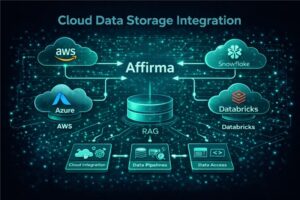
Provide deep integration with modern cloud data platforms to enable automated metadata harvesting, lineage capture, and semantic model mapping. The initial focus will be tight integration with Databricks lakehouse environments, followed by broader AWS cloud data platform integration, enabling Affirma to operate seamlessly within enterprise data lake architectures.
Key Product Functions
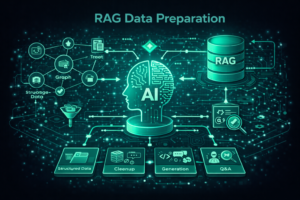
Prepare enterprise datasets and knowledge sources so they can support Retrieval-Augmented Generation (RAG) architectures used by generative AI applications. Affirma organizes enterprise knowledge through semantic relationships and metadata enrichment so LLMs can retrieve accurate context.
Key Product Functions
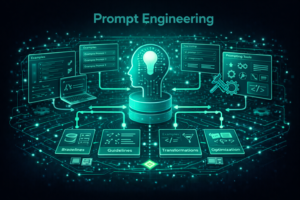
Translate natural language questions into structured queries by leveraging the semantic model, business glossary, and ontology relationships. Business users can ask questions in plain language and the platform maps the question to the correct datasets and fields.
Key Product Functions
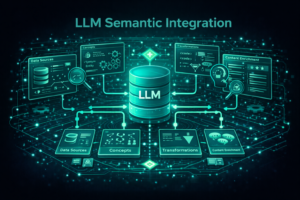
Integrate large language models directly with Affirma’s semantic layer and ontology framework so AI systems can interpret enterprise data using business context rather than raw schemas. The semantic model provides structured meaning, relationships, and governance metadata that guide LLM reasoning and reduce hallucinations.
Key Product Functions
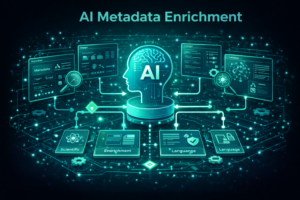
Use AI/ML techniques to automatically enhance metadata across datasets, schemas, and documentation. The platform analyzes table structures, column names, and usage patterns to infer business meaning, relationships, classifications, and ownership. This reduces the manual effort required to build a usable data catalog and helps rapidly scale governance programs.
Key Product Functions

Create the opportunity for either single user or enterprise licensing.
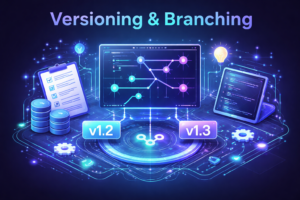
Implement version-controlled modeling with branching and governance workflows.

Enhance data modeling and quality by leveraging constraints, reference models, and advanced customization capabilities.